
ADHD Study Tips: The Complete, No-Fluff Guide to Studying With an ADHD Brain
- Nusrat Shabnam
- May 27
- 15 min read

By someone who actually understands how the ADHD brain works — drawing from clinical research, expert books, and thousands of real experiences shared by the ADHD community on Reddit and beyond.
If you've ever sat down to study, only to find yourself 45 minutes later deep in a Wikipedia rabbit hole about medieval siege weapons — you're not broken, lazy, or stupid. You have an ADHD brain, and it requires a completely different approach to learning than the advice mainstream productivity culture offers.
Standard study tips — "just focus," "make a schedule," "eliminate distractions" — were designed for neurotypical minds. For anyone studying with ADHD, these tips can feel not just unhelpful but actively discouraging, as if the problem is a failure of willpower rather than a difference in brain wiring.
This guide brings together the best ADHD study tips from clinical research, expert books like Extra Focus by Jesse J. Anderson and The ADHD Productivity Manual by Ari Tuckman, PsyD, MBA, and the unfiltered wisdom of real people with ADHD sharing what has actually worked for them in communities like r/ADHD. Whether you're a student in high school, college, or an adult learner, these study tips for ADHD are designed to work with your brain — not against it.
Let's get into it.
Understanding the ADHD Brain Before You Can Study With It
Before diving into the practical tips, it helps to understand why the ADHD brain struggles with traditional studying in the first place. This isn't a detour — it's the foundation of everything that follows.
It's Attention Dysregulation, Not Attention Deficit
The name "Attention Deficit Hyperactivity Disorder" is famously misleading. People with ADHD don't lack attention. What they experience is attention dysregulation — their brains take in too much information and struggle to filter what is truly important. This means an ADHD brain might lock onto the hum of an air conditioner, a notification sound three rooms away, or a mildly interesting thought that interrupts the lecture — all while desperately trying to pay attention to the task at hand.
This is why creating the right study environment matters so much more for people with ADHD than for neurotypical student.
The Interest-Based Nervous System


ADHD brains are not motivated by importance, deadlines (until they're truly urgent), or long-term rewards the way neurotypical brains can be. Instead, the ADHD nervous system is interest-based: it activates for things that are novel, challenging, personally interesting, or urgent. This explains why a student with ADHD can hyperfocus for six hours on a topic they love and can't manage 20 minutes on something they find dull — even if the dull topic is "more important."
Understanding this is liberating. The solution isn't to try harder. It's to engineer your study sessions to trigger that interest-based ignition.
Time Blindness Is Real
Many people with ADHD experience what researchers and clinicians call time blindness — a fundamentally different perception of time. For an ADHD brain, there is effectively "now" and "not now." A deadline that's two weeks away feels essentially the same as one that's two months away — until it's tomorrow, and suddenly it's a crisis.
This isn't procrastination in the conventional sense. It's a neurological difference in how future time is perceived and valued, and it requires specific strategies to work around.
Working Memory Limitations
Working memory — the mental "whiteboard" you use to hold information while thinking — is significantly affected by ADHD. A distraction during studying doesn't just interrupt your attention; it can wipe out what you were just reading or thinking about entirely. This is why ADHD studying tips must always address how to externalize information rather than relying on memory.
The 11 Best ADHD Study Tips (That Actually Work)
1. Solve the Task Initiation Problem First
For most people with ADHD, the single biggest obstacle to studying isn't staying focused — it's starting. The brain resists the transition into a task, especially one that doesn't feel immediately interesting. This is sometimes called "task initiation failure," and it has nothing to do with intelligence or effort.
The most effective studying tips for ADHD address this head-on:
The Five-Minute Rule: Commit to just five minutes of studying. Not an hour. Not a full chapter. Five minutes. The goal isn't to trick yourself — it's to lower the activation energy enough to get moving. The ADHD brain, once in motion, tends to stay in motion. The hardest moment is the transition.
"Eat the Ice Cream First": Most study advice tells you to tackle the hardest task first ("eat the frog"). For ADHD, this is counterproductive. Start with something small, easy, or genuinely interesting to build motivational momentum. Reviewing flashcards, re-reading notes from yesterday, or watching a short explainer video warms up the brain and makes tackling harder material feel more accessible.
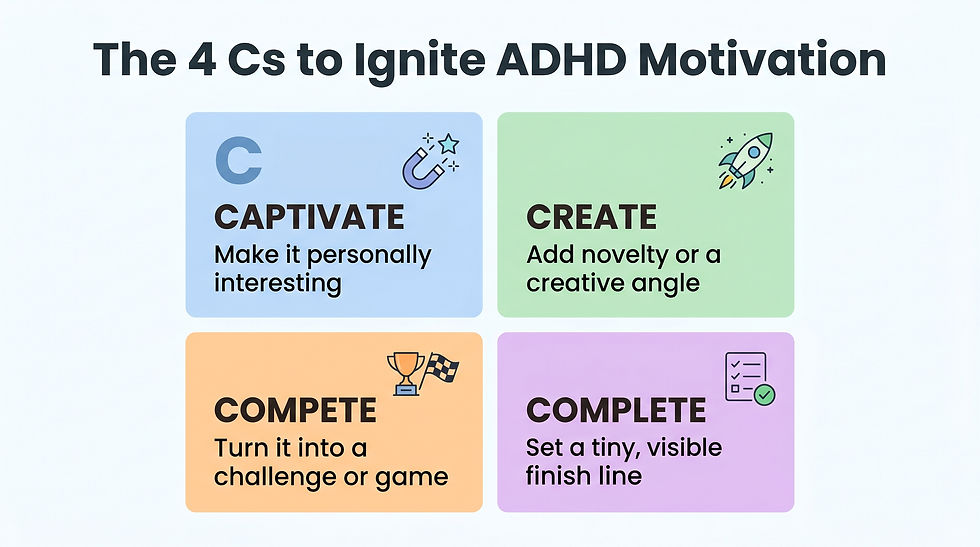
Use the 4 Cs: When facing a task that feels impossible to start, ask yourself how you can make it more: Captivating (add a personal hook — why does this actually matter?), Creative (find a novel way to engage with the material), Competitive (challenge yourself to beat a time or score), or Complete (set a very small, definable endpoint so the brain can see the finish line). Rotate through these strategies to maintain novelty and effectiveness.
2. Design Your Study Environment Like a Pro

The ADHD brain is extraordinarily sensitive to its surroundings. Research confirms that people with ADHD are more responsive to sensory input, meaning even moderate background noise — a ticking clock, distant chatter — can disrupt working memory and derail focus.
Manage noise strategically. Silence is often ideal, but unpredictable noise is the real enemy. Noise-canceling headphones, white noise machines, or focus-oriented music (binaural beats, lo-fi instrumental, brown noise) create a consistent audio environment that stops your ears from hunting for stimulation elsewhere. Many ADHDers in Reddit's r/ADHD community swear by this — one widely upvoted comment noted that the right background sound can make the difference between a productive hour and complete paralysis.
Use location shifting. Novelty is fuel for the ADHD brain. Studying in the same spot every day means the environment becomes invisible, and the brain starts seeking stimulation elsewhere. Move to a coffee shop, a library, a different room, or even outside when your current spot stops working. The change in environment provides enough novelty to re-engage attention.
Declutter ruthlessly. Visual clutter is cognitive noise for an ADHD brain. A desk covered in unrelated papers, snacks, and random objects competes for attention. This doesn't mean a sterile workspace — but it does mean clearing away things that aren't relevant to the current study session before you sit down.
Build a "launch pad." Before you start, have everything you need within arm's reach: water, your notes, your charger, your pencil. Every trip to get something is a potential derailing detour.
3. Use Time-Based Goals, Not Outcome-Based Ones

"I'll study until I finish this chapter" is a recipe for ADHD frustration. Chapters are unpredictable in length and complexity. When a task takes longer than expected — which it often does when you're also managing distractions — the gap between expectation and reality becomes demoralizing.
Switch to time-based goals instead: "I will study for 40 minutes" is clear, finite, and manageable. You always know when you're done. This removes the moving goalpost and reduces the overwhelm that triggers avoidance.
The Pomodoro Technique is the most popular implementation of this idea, and for good reason — it was practically designed for ADHD brains. Work for 25 minutes (or whatever interval suits you), then take a 5-minute break. After four cycles, take a longer break of 15–30 minutes. The defined intervals give the ADHD brain the urgency it needs, while the built-in breaks prevent the mental fatigue that leads to shutdown.
Use visual timers. Abstract time doesn't register well in the ADHD brain. A visual timer — one that physically shows time shrinking, like a Time Timer — makes the passage of time tangible and creates a sense of urgency that helps sustain focus. This is one of those tips for studying with ADHD that sounds almost too simple but has an outsized effect.
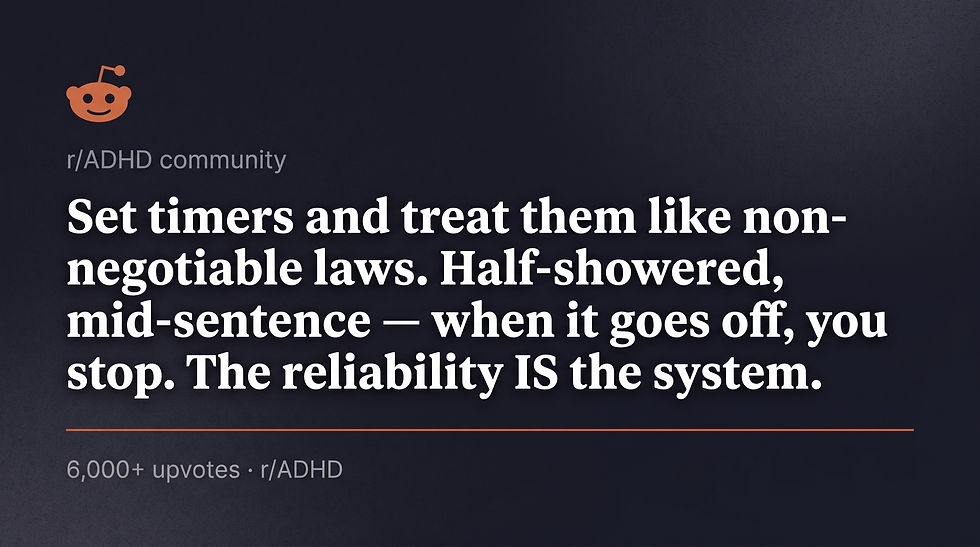
A widely shared piece of advice from Reddit's ADHD community: set your phone clock 10–15 minutes fast on purpose, and treat timers as non-negotiable laws. When the timer goes off, you stop — whether you feel done or not. This preserves the reliability of the system, which is what makes it work.
4. Body Doubling: The Social Focus Hack

Body doubling is one of the most consistently effective and underused ADHD studying tips in existence. The concept is simple: you work alongside another person — in person or virtually — while studying. The other person doesn't have to help you, explain anything, or even be doing the same task. Their mere presence changes how the ADHD brain performs.
Why does this work? Dr. Edward Hallowell, psychiatrist and author of multiple books on ADHD, has noted that people with ADHD respond in an almost remarkable way to the social presence of another person — it activates accountability and anchors attention to the present moment. A 2025 study on body doubling in virtual reality found that participants completed tasks faster and perceived greater sustained attention when working alongside another person compared to working alone.
How to use body doubling for studying:
Study with a friend in the same physical space (you don't need to be doing the same subject)
Join a virtual co-working session via platforms like Focusmate or Study Together on Discord
Log onto a "study with me" YouTube livestream — millions of hours of these exist specifically for this purpose
Ask a classmate or roommate to sit nearby while doing their own work
The r/ADHD community is passionate about this. As one frequently cited comment puts it, body doubling works because it introduces the social element that the ADHD brain responds to — when someone else can see you, the threshold for getting distracted rises significantly.
5. Do a "Mind Dump" Before Every Session
Working memory in ADHD is limited and easily disrupted. If you sit down to study with a mental to-do list swirling around your head — a text you forgot to reply to, a dentist appointment to schedule, a worry about tomorrow's deadline — those thoughts will compete for cognitive resources the entire time you're trying to learn.
The solution is the mind dump: before you open a single textbook, spend 5 minutes writing down every thought, task, worry, or random idea floating around in your head. Put it all on paper. This "clears the mental shelf," giving your working memory room to actually hold the study material.
This technique is referenced repeatedly across the ADHD community. A whiteboard next to your desk works especially well — the physical act of writing and the visibility of the list helps the brain let go of the mental juggling act.
6. Externalize Absolutely Everything
The ADHD brain operates on "out of sight, out of mind" in a very literal way. Instructions you don't write down will likely disappear. Deadlines stored only in your head will sneak up on you. Notes that seem clear in the moment will be opaque two days later.
The guiding principle for studying with ADHD is to externalize as much cognitive load as possible:
Record lectures (with permission) and use transcription apps to create searchable notes
Repeat instructions back to professors or teachers to confirm you've understood them correctly
Use a single, reliable reminder system — one app with persistent notifications, not three different apps you half-use
Write study goals on a whiteboard visible from your desk so they stay in your field of attention
Break down large assignments into specific written sub-tasks with their own mini-deadlines
The key word is specific. "Study for the exam" is not a useful note. "Re-read Chapter 4 and make flashcards for the key terms (pages 78–82)" is actionable and concrete. The ADHD brain needs clarity; ambiguity triggers avoidance.
7. Leverage Movement and Your Physical "Battery"
The connection between physical activity and ADHD brain function is one of the most well-supported findings in neuroscience. Exercise raises dopamine and norepinephrine levels — the same neurotransmitters that ADHD medications target. Studying immediately after cardio exercise can meaningfully improve attention, working memory, and motivation.
Practical strategies:
Schedule a workout, walk, or even a 10-minute jog before your most challenging study session of the day
Use movement breaks intentionally during study sessions — not just "rest," but actual movement. Jump jacks, a quick walk, stretching
Allow fidgeting tools during study: stress balls, textured rings, or putty occupy the hands and can actually improve focus by satisfying the ADHD brain's need for physical stimulation without derailing attention
Sleep is equally critical. Even a 30-minute improvement in sleep quality can noticeably reduce the cognitive "fog" that makes studying feel impossible. The ADHD brain already runs on thinner executive function reserves — sleep deprivation makes every symptom worse.
8. Color-Code, Mind Map, and Make It Visual
ADHD brains often respond well to visual organization. Color-coding notes creates multiple memory retrieval pathways — you might not remember the exact phrasing of a concept, but you remember it was written in blue, which triggers the associated memory. This turns passive reading into an active, organizational task that keeps engagement higher.
Practical visual study strategies:
Assign a consistent color system before you start (e.g., red for key definitions, blue for examples, green for connections to other concepts) — but limit it to 3–4 colors to avoid visual overwhelm
Use mind maps to visualize how concepts connect, rather than linear notes that the ADHD brain often finds less engaging
Draw diagrams and charts rather than just writing summaries
Use sticky notes on a whiteboard or wall to organize ideas spatially
Reddit's ADHD community frequently recommends Notion, Obsidian, or even just old-fashioned index cards for creating visual, interconnected notes that feel more like building something than copying text.
9. Manage the "Waiting Mode" and Pre-Study Anxiety
One underappreciated ADHD study challenge is Waiting Mode — the paralysis that sets in when you know you have to study "soon." Many people with ADHD find it impossible to start other activities if they know a study session is coming up in an hour, but they also can't bring themselves to start studying early. The brain gets stuck in limbo.
Strategies that help:
Schedule study sessions with a hard, specific start time (not "this afternoon" — "3:00 PM") so the ambiguity is removed
Design a brief pre-study ritual — make a specific drink, put on specific music, clear your desk — that signals to your brain that studying is beginning. Rituals reduce the friction of transitions
Transform waiting time into something intentional rather than anxious: a short walk, a specific playlist, or a light review of notes from the last session
10. Handle Emotional Dysregulation During Study Sessions
ADHD is not just an attention condition — it's also an emotional regulation condition. Frustration, boredom, and discouragement hit harder and faster for ADHD brains. When studying triggers these feelings, avoidance behavior activates almost automatically.
Success amnesia is a related phenomenon: ADHD brains tend to remember failures vividly while successes fade quickly. This creates a skewed internal narrative that says "I always fail at studying" — which makes starting feel even harder.
Counter this with:
Logging small wins: Keep a brief daily note of what you did accomplish, even if it's just "reviewed two pages." This builds an evidence base against the success amnesia
Expanding your frustration vocabulary: When studying feels overwhelming, pausing to label the specific emotion (frustration? boredom? fear of failure?) can reduce its intensity enough to continue
Using the "pause and reset" strategy: When you feel yourself about to slam the textbook shut and give up, take a 3-minute break with a completely different activity, then return — rather than ending the session entirely
11. Build Momentum Gradually — and Pivot When Needed
One of the most important concepts in both Extra Focus and The ADHD Productivity Manual is that productivity systems for ADHD must be treated as living, evolving tools — not fixed solutions. The moment a strategy loses its novelty and stops working, it needs to be refreshed or replaced. This isn't failure. It's ADHD.
Start small and build up. The metaphor of a train is apt: you don't start a train at full speed. You build momentum gradually. Beginning with a tiny, winnable task gets the brain moving. Once moving, adding more becomes easier.
Embrace pivoting. When your current system stops working — and it will — this is not a personal failure. It's information. Rotate your environment, your Pomodoro length, your music, your location. What works is what keeps working; nothing works forever for an ADHD brain.
What Reddit's ADHD Community Says Actually Works
The r/ADHD subreddit is one of the largest communities of people with ADHD sharing raw, unfiltered, real-world experiences. A viral post that collected over 6,000 upvotes and 150 awards generated some of the most honest studying tips for ADHD on the internet. Here's what people with ADHD consistently say has genuinely changed their studying:
"Do cardio before you need to focus." This came up repeatedly — not as a vague wellness suggestion, but as a specific, high-impact intervention. Multiple Redditors described it as the single biggest lever they'd found.
"Set timers and treat them like non-negotiable laws." Half-showered, mid-sentence, whatever — when the timer goes off, you stop or switch. The reliability of the system is what makes it work. Abandoning it even once weakens it.
"Use spaced repetition — it feels like cheating the memory issues." Tools like Anki, which space out review of flashcards based on how well you know them, are widely loved in the ADHD community because they externalize the decision of what to review and when — eliminating the paralysis of planning and reducing the grinding repetition of re-reading notes.
"Keep things at eye level." This sounds mundane but is deeply practical. Notes, to-do lists, and reminders on your desk or whiteboard — visible in your field of vision — stay in working memory. Notes tucked in a folder effectively cease to exist.
"Body doubling changed everything." Across dozens of threads, body doubling emerges as one of the most universally effective strategies. Even virtual versions — Zoom calls with a friend, livestream study sessions, or co-working apps — provide enough social presence to make a real difference.
"The five-minute commitment is real." Multiple Redditors describe making a "deal" with themselves to just open the textbook for five minutes. The barrier was getting started — once started, the session often continued naturally.
Special Section: Studying With ADHD in College
College presents a unique set of challenges for ADHD students because many of the external structures that helped in high school — parents monitoring homework, smaller class sizes, more frequent check-ins — disappear. Suddenly, a student is fully responsible for managing their own time, deadlines, and motivation.
Request accommodations early. Most colleges and universities offer disability services that can provide extended test time, quiet testing rooms, note-taking assistance, and other formal supports. These aren't advantages — they're tools that level the playing field for a brain that processes differently.
Build a social support structure. Find accountability partners, study groups, or ADHD peer communities. The social element of accountability is particularly powerful for ADHD brains (see: body doubling). Knowing someone else is expecting you to show up is sometimes the only reliable activation trigger.
Communicate with professors. A brief, honest conversation with a professor early in the semester — explaining that you have ADHD and may need to ask clarifying questions or use a recorder — can prevent enormous anxiety and misunderstanding later.
Watch out for "procrastivity." This is the ADHD trap of staying busy with easier, low-priority tasks (organizing your desk, making color-coded tabs, re-reading notes you already know) to avoid the harder work that actually matters. Recognizing it is the first step to interrupting it. This trap is covered extensively in the best productivity books of 2026 — books like The One Thing and Essentialism are particularly useful for tackling it.
The Role of Sleep, Nutrition, and Exercise
No article on tips for studying with ADHD would be complete without addressing the physical foundation. The ADHD brain is already working harder to manage executive function — depleting this system further with poor sleep, poor nutrition, or a sedentary lifestyle makes every single study session harder.
Sleep: Sleep deprivation worsens every ADHD symptom. Even small improvements — going to bed 30 minutes earlier, using blue light filters in the evening, keeping a consistent wake time — yield noticeable cognitive benefits.
Exercise: As noted earlier, cardio exercise produces an immediate, meaningful boost to the neurotransmitters that underlie focus and working memory. Even a 20-minute walk before studying is beneficial.
Nutrition: Blood sugar stability matters. The brain needs consistent fuel. Studying on an empty stomach or after a sugar crash creates additional cognitive noise. Protein-rich snacks and regular meals help maintain steadier attention over a study session.
Medication: For those who are prescribed ADHD medication, timing it appropriately relative to study sessions matters. This isn't a topic for general advice — but it's worth a conversation with a prescribing doctor if timing feels misaligned with your study schedule.
A Note on Self-Compassion
Studying with ADHD is genuinely harder than studying without it. That is not an excuse — it is a fact supported by decades of clinical research. Middle school students with ADHD turn in measurably fewer assignments and earn lower grades not because they're less capable, but because the systems that school is built around are not designed for how their brains work.
The goal of every strategy in this guide is the same: to reduce the friction between what you intend to do and what you actually do. Some strategies will work immediately. Some will work for a while and then stop. Some won't work at all for your particular brain.
That's not failure. That's ADHD. The practice is iteration — finding what works, using it until it doesn't, and replacing it without judgment.
As both Jesse J. Anderson and Ari Tuckman emphasize in their respective books: living well with ADHD means working with your brain, not fighting it. The goal isn't to force your ADHD brain to behave like a neurotypical one. It's to build systems, habits, and environments that let your actual brain — with all its quirks and superpowers — do its best work.
And if you're looking for more on self-compassion, letting go of things outside your control, and shifting your relationship with your own mind, our review of The Let Them Theory by Mel Robbins is worth a read — it carries a surprisingly powerful message for anyone who has spent years fighting their own brain.
Quick Reference: ADHD Study Tips at a Glance

Task initiation: Use the Five-Minute Rule, "eat the ice cream first," and the 4 Cs (Captivate, Create, Compete, Complete)
Environment: Noise-canceling headphones, location shifting, decluttered desk, a "launch pad" of everything you need
Time management: Time-based goals, Pomodoro technique, visual timers, treating alarms as non-negotiable
Body doubling: Study with someone physically present, via Zoom, Focusmate, or a "study with me" livestream
Memory: Mind dump before each session, externalize everything, write it down, use spaced repetition (Anki)
Visual learning: Color-coding systems (max 4 colors), mind maps, diagrams over dense linear notes
Movement: Cardio before studying, movement breaks, fidget tools during sessions
Emotional regulation: Log small wins, name the emotion, use pause-and-reset rather than full session abandonment
Momentum: Start tiny, rotate strategies, embrace pivoting as a feature, not a failure
Sources
Anderson, Jesse J. Extra Focus: The Quick Start Guide to Adult ADHD. 2022.
Tuckman, Ari, PsyD, MBA. The ADHD Productivity Manual. Specialty Press, 2023.
ADDitude Magazine. "How to Study Better with ADHD: 7 Ways to Earn Better Grades." Updated October 2025.
Amen Clinics. "Boost Focus with 10 ADHD Study Tips." August 2025.
ADD.org (Attention Deficit Disorder Association). "How to Study Efficiently with ADHD: 7 Tips to Boost Focus & Motivation." August 2023.
Sachs Center for ADHD. "Top Study Strategies for ADHD in 2025 That Boost Success." September 2025.
Healthline. "Study Tips for ADHD." 2022.
Healthline. "ADHD Body Doubling."
Queens Online School. "8 Unmissable Study Tips ADHD Learners Need." October 2025.
Beat ADHD / Substack. "131 Pro-Tips from ADHD'ers" (compiled from r/ADHD Reddit thread with 6,000+ upvotes). 2020.
Ara, Zinat et al. "You Are Not Alone: Designing Body Doubling for ADHD in Virtual Reality." 2025.
NPR / Hallowell, Dr. Edward. "Body Doubling for ADHD."
Open University. "Studying with ADHD."
r/ADHD community (Reddit). Various threads on studying tips, body doubling, and task initiation strategies.


This article provides some really useful tips for studying with an ADHD brain. For students in the UK who might be looking for last minute assignment help in UK understanding how your brain works can make a big difference in managing deadlines and staying focused. These strategies can help you work smarter and more efficiently, even when time is tight. It’s great to see practical advice rooted in real experiences — definitely helpful for anyone needing that extra support to get through last-minute crunches!